

Is fake news the real threat or just the visible face of disinformation?
Artificial intelligence has made it easier to generate false content. Deepfakes can be produced in minutes. Political claims can be multiplied at scale. Synthetic images, fake videos, and automated comments now circulate across platforms where public opinion is formed, contested, and manipulated.
It is tempting to conclude that democracy is facing a new “fake news apocalypse.”
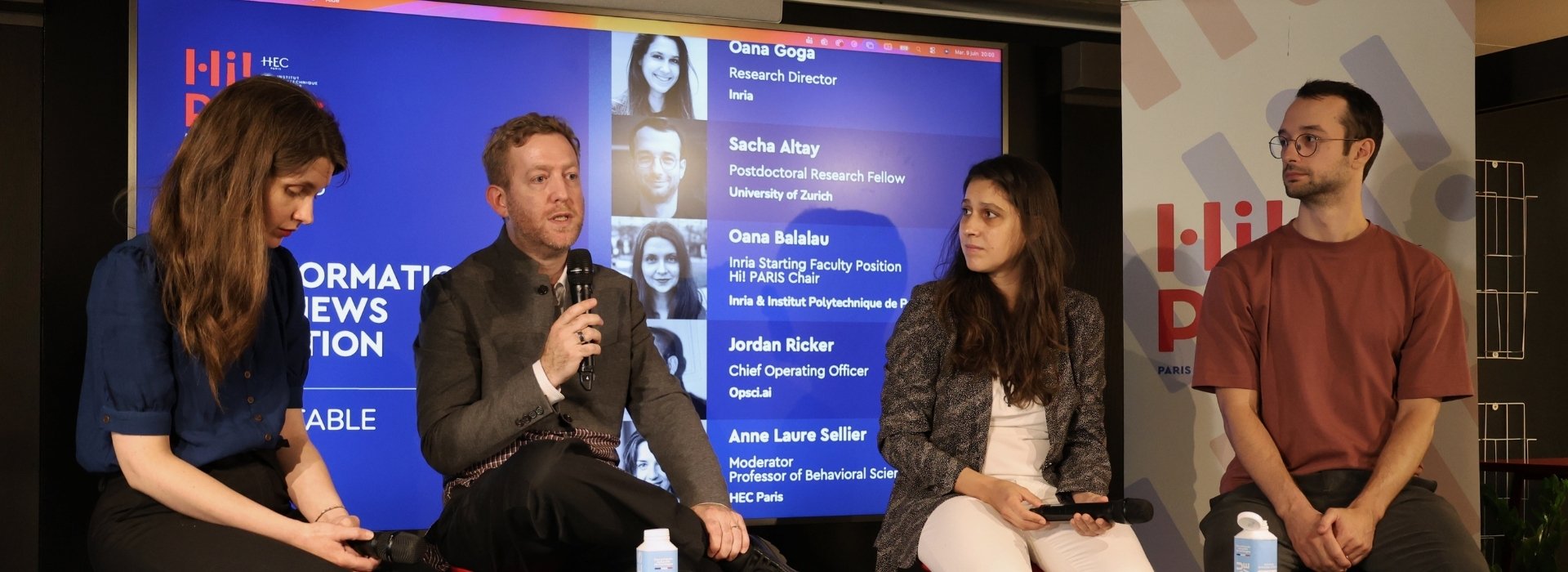
Yet the researchers and practitioners gathered for the recent Meet Up on AI & Disinformation: Fake News Detection offered a more complex diagnosis. Across four presentations and a roundtable discussion, a different picture emerged: fake content matters, but it may not be the center of the problem. The deeper issue is not only whether information is true or false. It is how people encounter information, what they choose to believe, which emotions are being activated, who benefits from amplification, and how AI systems are becoming part of the public sphere itself.
The core question, then, is not simply: Can AI create more fake news? But what happens when information systems become harder to audit, easier to manipulate, and more detached from shared trust?
The essential points
Disinformation exists, but available research suggests that average exposure to clearly false news is lower than public debate often assumes.
Algorithms matter, but user choices, political identity, distrust, and emotional grievances also change what people consume and share.
Fact-checking remains necessary, but many influential narratives are vague, emotional, or opinion-based, making them difficult to verify.
AI can help journalists, researchers, and institutions detect claims, map narratives, and audit platforms.
The next challenge is not only fake news on social media. It is the role of conversational AI systems as new gateways to political information.
Fake news is visible, but not always dominant
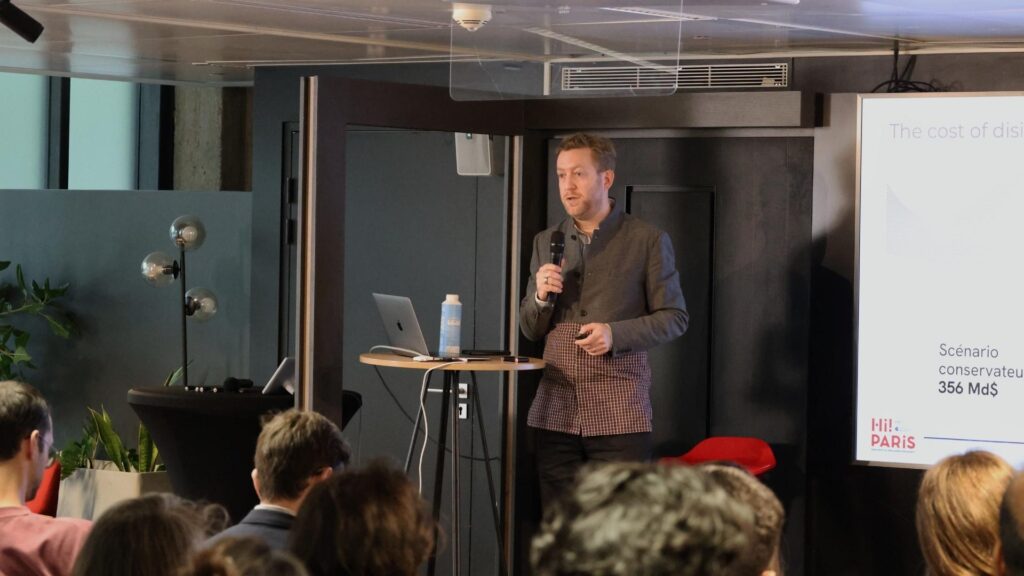
Oana Goga, research director at Inria, began with a basic question that is surprisingly difficult to answer: How much disinformation do people actually see online?
The difficulty, she explained, comes from the structure of online platforms. Social media feeds are closed environments. Researchers, journalists, and regulators often cannot observe what users actually encounter. To address this, her team built Check My News, a tool that allows citizens to donate private platform data for research, in the same spirit that someone might donate blood for medicine. The tool was deployed before elections in the United States and Brazil, with around 1,000 users in each campaign.
The findings complicate the dominant narrative. According to the data she presented, about 60% of news related posts users saw came from factual sources, while around 5% came from sources known to have spread disinformation in the past. The rest fell into mixed or unknown categories. The conclusion was not that disinformation is harmless. Five percent can still matter, especially during elections. But it does suggest that disinformation is not the dominant source of news in most users’ feeds.
The same nuance applies to algorithms. Social media is often described as a machine that pushes users into falsehoods and ideological bubbles. Goga’s work suggests a more distributed responsibility. Users were more likely to encounter disinformation because they had chosen to subscribe to sources known for spreading it than because algorithms or friends had inserted it into their feeds.
This does not absolve platforms. Their design still changes what becomes visible. But it shifts the question from “Are algorithms manipulating everyone?” to “How do platforms, users, networks, advertisers, and political actors interact?” That distinction matters. If the diagnosis is wrong, the response will be too.
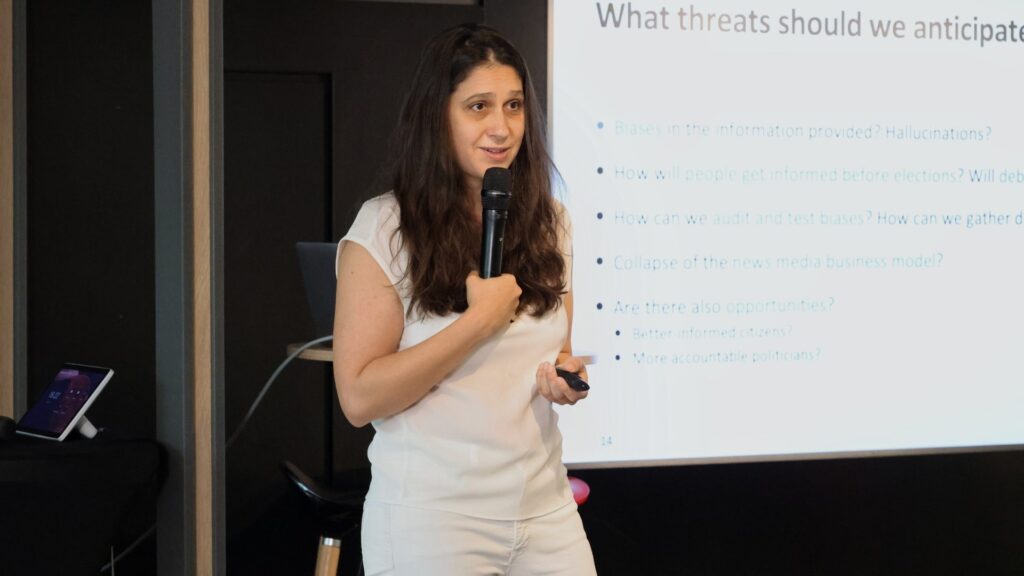
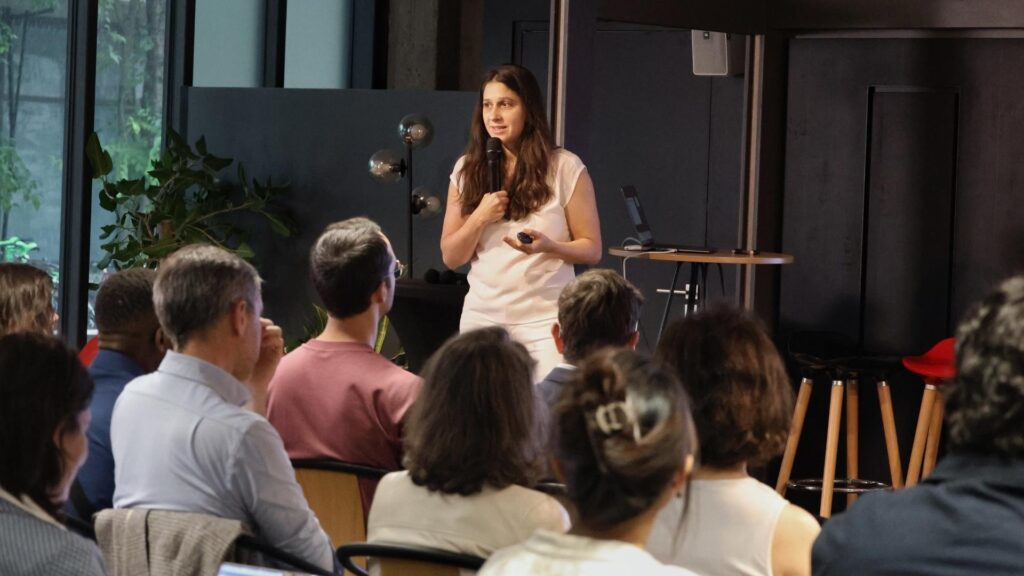
Oana Goga (Inria) at Station F during the Meet Up on AI & Disinformation: Fake News Detection
Filter bubbles are more complicated than they look
The same research also revisits the idea of filter bubbles. When Goga’s team looked only at the pages users chose to follow, just 13% had politically balanced information diets. But when the full information diet was considered, including content from networks and recommendations, 35% of users had balanced exposure.
In other words, people often choose ideologically aligned sources. But platforms and social networks may also expose them to more diversity than their own subscriptions would suggest. This does not mean digital public debate is healthy. It means the mechanisms are less simple than the usual story. The way users interact with information adds another layer. Goga’s team found that users clicked to read an article before sharing it only 14% of the time. Most sharing happens without reading the content behind the headline.
Yet another finding was more encouraging. When users encountered articles from opposing political views, they were less likely to like or share them publicly, but they did sometimes click and read them privately. Public behavior may look more polarized than private curiosity. That gap matters. It suggests that online interaction metrics do not fully capture what people think, doubt, or explore.
Fact-checking is too slow for the volume of claims
If Oana Goga focused on exposure, Oana Balalau, Inria Starting Faculty Position & Hi! PARIS Chair, focused on verification. Her starting point was blunt: the enemy of fact checking is not only falsehood. It is volume, unstructured data, and vague language.
A false statistic can be created in seconds. Manual verification can take hours. This asymmetry gives disinformation a structural advantage.
To help close that gap, Balalau presented StatCheck, a tool developed with Radio France and Franceinfo. The system detects statistical claims in text, generates queries, and compares those claims with reliable databases such as INSEE and Eurostat. The aim is not to replace journalists. It is to help them move faster. The journalist remains responsible for the fact-check. The tool helps identify what needs checking and where relevant evidence may be found.
This is the clearest case for AI as a support system for public information: not generating content, but helping professionals verify it.
Yet Balalau’s second example showed the limits of fact checking when claims are not precise enough to verify. Her team studied more than 1,000 corporate transition plans to evaluate whether companies’ climate commitments could be assessed. The result was striking: 80% of the plans contained at most two measures with quantitative information, and only nine out of roughly 1,100 plans provided enough numerical information to estimate whether the companies could meet their carbon reduction goals.
The issue is that many claims were too vague to test. “Improve energy efficiency” may sound responsible. But without scope, timeline, quantified targets, and expected impact, it cannot be meaningfully verified. This is where fact-checking meets regulation. If actors are not required to disclose precise information, there may be nothing solid to check.
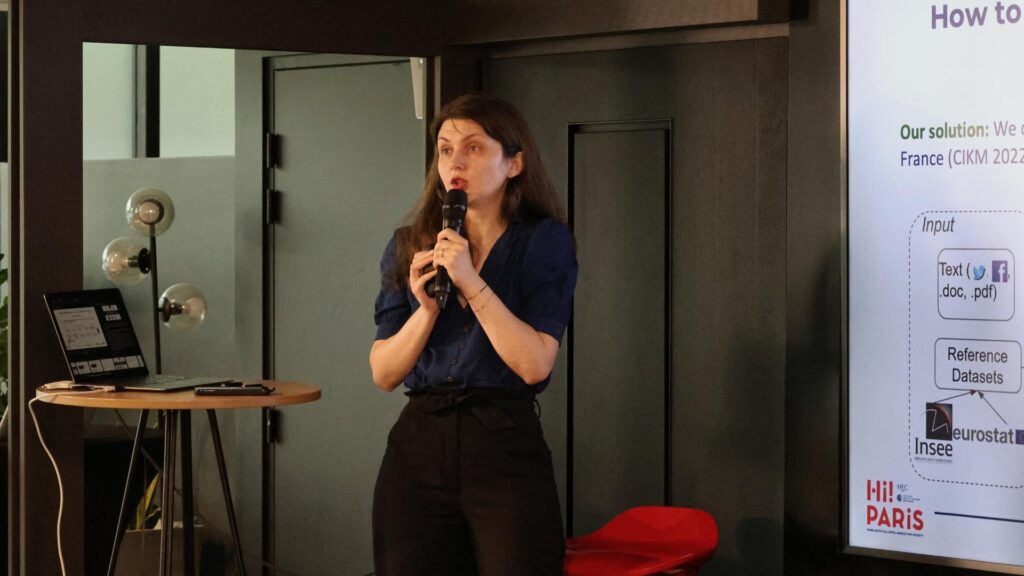
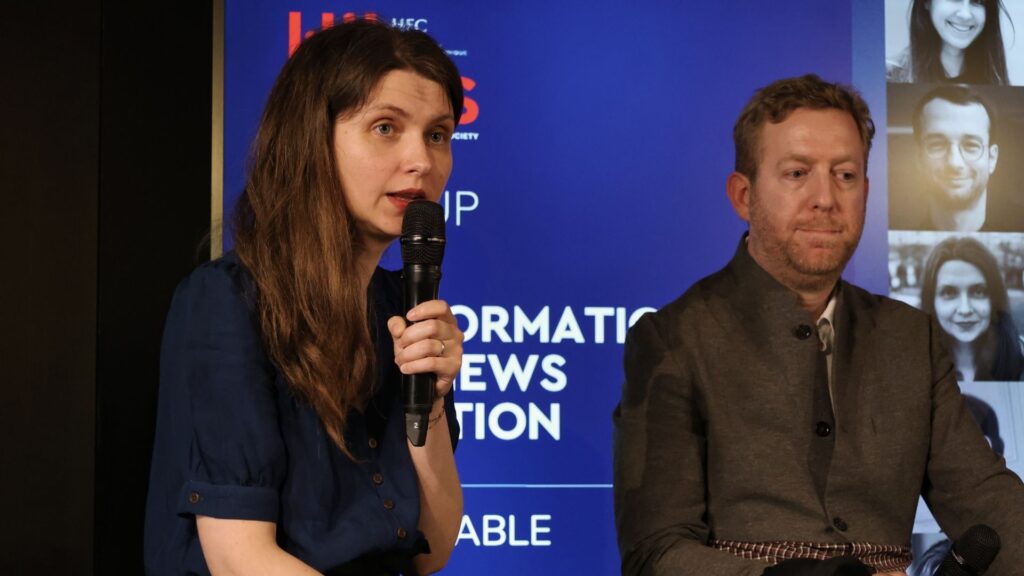
Oana Balalau (Inria & Institut Polytechnique de Paris) at Station F during the Meet Up on AI & Disinformation: Fake News Detection
The hardest disinformation may not be false
Balalau’s final point moved beyond factual accuracy. Many manipulations do not rely on explicit falsehoods. They rely on omission, framing, selective evidence, or emotional emphasis.
A text can contain only true facts and still mislead. This is one of the central challenges for the next generation of fact-checking. Detecting whether a number is wrong is difficult but manageable when a reliable database exists. Detecting whether a text hides relevant context, presents only one side of an issue, or uses deceptive framing is harder. Balalau described this as the need to go “beyond facts.” Future tools will need to detect bias, propaganda techniques, fallacies, and one-sided framing, while avoiding the danger of becoming arbiters of opinion.
That balance is delicate. But it is increasingly necessary, because much of what circulates online is not a factual claim. It is grievance, insinuation, identity, or suspicion.
People are less gullible than we think
Sacha Altay, postdoctoral researcher at the University of Zurich in social psychology, challenged another widespread assumption: that people are easily fooled by fake news.
His argument was not that disinformation is irrelevant. It was that public debate often exaggerates both its reach and its persuasive power. He pointed to research since 2016 suggesting that disinformation consumption on major platforms is generally low, often around 5% or below. During the COVID-19 pandemic, when many warned of an “infodemic,” his work at Oxford examined news consumption in the United States, France, Germany, and the United Kingdom. The pattern was consistent: when the pandemic intensified in March 2020, people consumed more news, but mainly turned to mainstream and more reliable outlets.
Altay’s broader point was that many false beliefs do not come from direct exposure to fake news. They may come from lack of exposure to reliable information, distrust of institutions, or refusal to accept credible sources. That distinction changes the response. The problem is not only how to reduce disinformation. It is how to increase trust in reliable information. Altay also emphasized what he called a skepticism bias. In a meta-analysis of studies on how people judge true and false news, he found that participants were generally able to distinguish between them. They made mistakes, but often more by doubting true news than by believing false news.
In other words, the public may not need only more skepticism. In some contexts, people may need better reasons to trust.
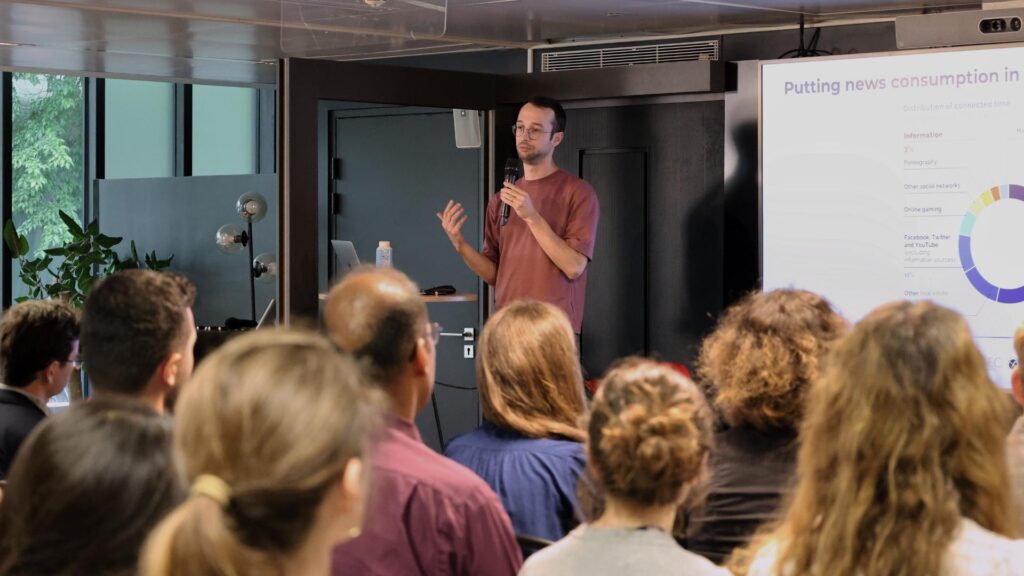
Sacha Altay (University of Zurich) at Station F during the Meet Up on AI & Disinformation: Fake News Detection
Disinformation is often a symptom, and AI changes how we track it
One of the strongest points of convergence during the Meet Up was that disinformation is not only a cause of political dysfunction. It is also a symptom. Sacha Altay used the image of a tree. Disinformation is the leaves: visible, abundant, easy to point at. But the roots are deeper. They include distrust, anger, political alienation, perceived corruption, and distance from institutions.
Jordan Ricker, Chief Operating Officer at Opsci.ai, made a similar point from the perspective of information intelligence and narrative monitoring. For him, the key question is not always whether a piece of content is fake. In many cases, fake content works because it activates something that already exists: fear, resentment, humiliation, anger, or distrust. This is why Ricker is less interested in fake news as isolated content than in narratives: the emotional and ideological structures through which content spreads. A false image may disappear. The narrative remains.
He also pointed to a difficult mechanism for journalists and media organizations: amplification through coverage. In the case of the rumor about an alleged bag of cocaine in Emmanuel Macron’s hand on a train, the narrative existed in far-right and conspiratorial circles before becoming widely visible. What made it grow was not only the original claim, but the broader media cycle around it.
The problem is not fact-checking itself. It remains necessary. The problem is the media economy in which debunking can become another form of circulation. AI changes the response by making large-scale monitoring possible. Opsci uses AI to monitor narratives across countries, languages, platforms, and topics. The purpose is not only to detect individual falsehoods. It is to identify patterns of propagation: which narratives are growing, which communities are amplifying them, which rhetorical devices are being used, and where coordinated behavior may be emerging.
Before AI, coordination detection often relied on identical wording. Now, models can help identify similarity of ideas, even when the wording changes. That does not remove the need for human judgment. It makes large-scale monitoring possible.
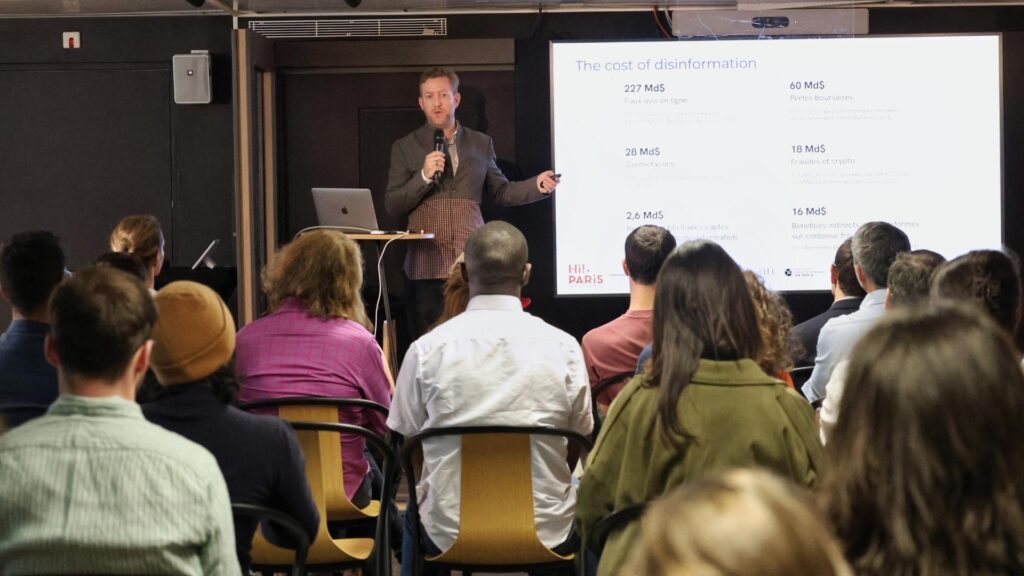
Jordan Ricker (Opsci.ai) at Station F during the Meet Up on AI & Disinformation: Fake News Detection
The next public sphere may be conversational
As the speakers noted, disinformation is no longer confined to social media platforms. It is also entering conversational AI systems.
This may be the next frontier. More people are asking conversational AI systems about politics, public policy, elections, science, and social issues. These systems do not simply list links. They synthesize, summarize, and often speak with a tone of confidence. That raises new questions. Which sources do they use? How do they rank credibility? Can they reproduce disinformation narratives? Can they be influenced by low-quality websites? What happens in long conversations, when users move away from mainstream sources into the long tail of information?
Oana Goga noted that researchers need better access to the data used to train and audit these systems. Jordan Ricker described daily testing in which Opsci injects recently debunked narratives into major LLMs to see whether models relay them, distance themselves from them, or help reproduce them.
The picture is mixed. Models are improving at refusing to replicate disinformation and at contextualizing narratives. But they are not inherently ethical. They can also validate questionable reasoning or encourage conspiracy-style thinking. The risk is not only that AI generates fake content. It is that AI becomes a trusted mediator of reality without sufficient transparency. Still, the discussion did not end in pessimism. AI can help journalists detect statistical claims, help fact-checkers draft corrections, help citizens understand political programs, and help researchers audit platforms. But legitimacy still depends on human review, plural judgment, and transparent process.
When asked whether they were worried about the next presidential election, the speakers were clear: yes, but not only because of fake content. Ricker pointed to the emotional drivers disinformation exploits. Altay pointed to distrust in institutions. Goga warned that coordinated campaigns increasingly operate through comments, changing how users perceive public opinion. Balalau raised the question of who funds narratives, who owns media outlets, and who benefits from redirecting anger toward vulnerable groups.
Together, these answers suggest that disinformation cannot be solved only by better detection tools. It also requires platform access, data transparency, media responsibility, regulation, political accountability, and renewed trust in institutions.
What changes, concretely
AI can flood platforms with synthetic content. That much is clear. The harder question is whether volume is really the problem.
Fake news is part of the problem, but not the whole problem. The information crisis is also about vague claims that cannot be checked, true facts arranged in misleading ways, emotional narratives that travel faster than corrections, media incentives that amplify what they debunk, and public distrust that makes some citizens actively seek anti-institutional explanations.
AI intensifies these tensions. It lowers the cost of producing content. It helps detect patterns. It can support fact-checking. It can also become a new arena for manipulation, persuasion, and source selection.
The most important question is therefore not whether AI will make disinformation cheaper. It will.
The question is whether societies can build the capacity to audit, verify, contextualize, and respond without reducing the problem to technology alone. Because the weakness disinformation exploits is not only informational. It is social.
And repairing that weakness will require more than better models. It will require better institutions, better journalism, better regulation, and a public sphere where citizens have reasons not only to doubt what is false, but to trust what is true!