
AI at work and what it really means for productivity and people
Artificial intelligence is everywhere in the conversation about work. It is described as a revolution. A disruption. A threat. A productivity miracle.
Yet when practitioners, economists, labor market researchers, and entrepreneurs sit in the same room, the picture becomes more nuanced, and more interesting. That was the goal of the Meet Up we recently organized on AI and the future of work. Across four complementary perspectives, from large-scale corporate deployment to macroeconomic modeling, labor market experimentation, and educational innovation, a more grounded story emerges:
AI is not transforming work through instant automation. It is changing systems, incentives, and access to opportunity, slowly, unevenly, and often invisibly.
Inside firms, AI is more infrastructure than intelligence
From the vantage point of global consulting projects, the first surprise is how little of AI is truly “cutting edge.” According to Etienne Grass, who oversees AI strategy at Capgemini Invent, roughly 80% of deployed AI use cases are not agentic systems or autonomous workflows. They are traditional machine learning models, data classification, extraction, optimization.
Generative AI is used extensively. But primarily for:
-
Code generation across the development lifecycle
-
Document management and search
-
Internal copilots
Productivity expectations are equally sobering. Clients expect around 8% productivity gains. Sometimes projects deliver 30% or 40%. Sometimes 2% or 3%. The variation is enormous. And then comes the hidden constraint: adoption.
Excitement peaks in the first week. Usage drops sharply afterward. In many copilot deployments, fewer than half of users remain active beyond initial experimentation. The core issue is not the model. It is the system. Moving from 80% accuracy to 95% accuracy in retrieval-augmented systems can take months. Agentic workflows, those chaining multiple models and decision steps, are technically feasible but operationally fragile. Most enterprise projects remain constrained by data quality, interoperability, governance, and security.
The most advanced client example cited involved more than 1,000 internal agents deployed, but only after rebuilding foundational data architecture over 18 months. The lesson is clear: AI at scale is less about intelligence and more about infrastructure.
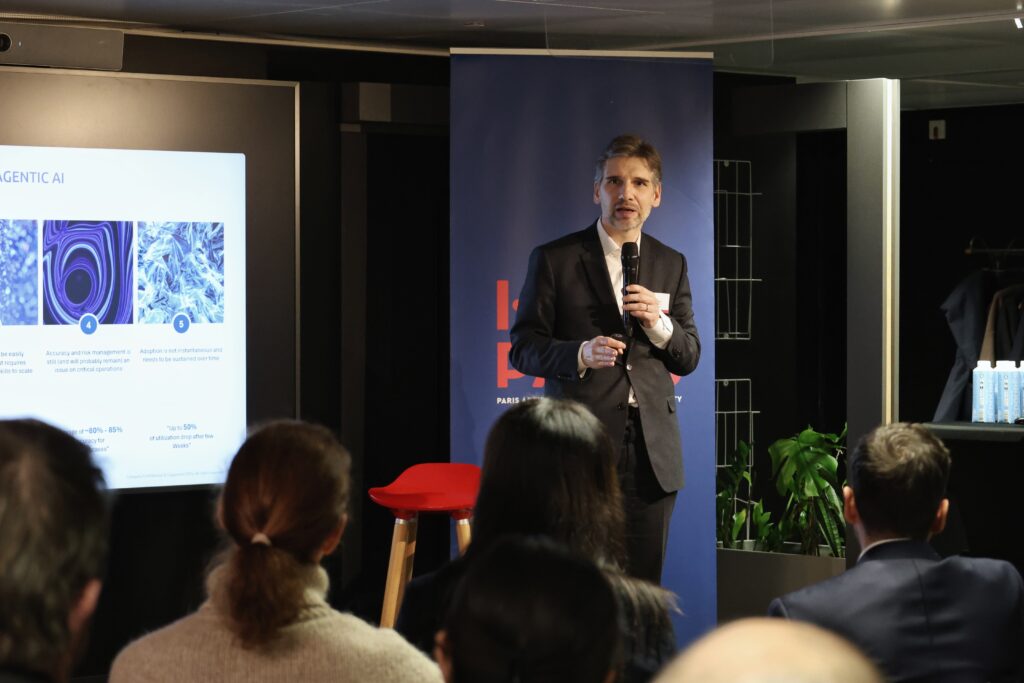

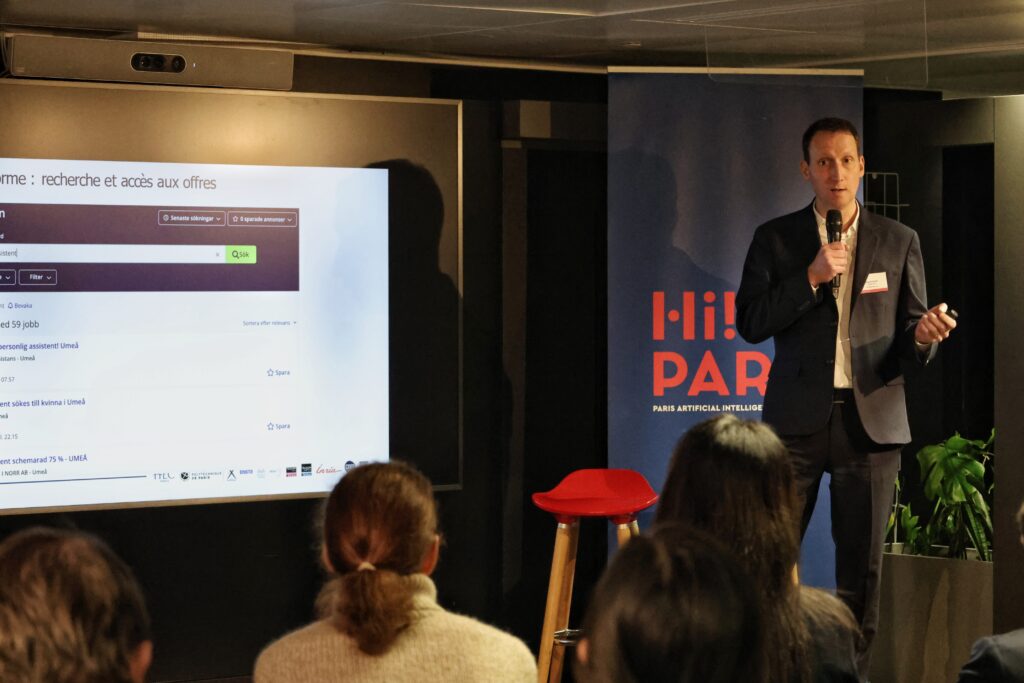
Etienne Grass (Capgemini Invent – Capgemini) at Station F during the Meet Up on AI & The Future of Work
Productivity gains will likely be incremental, not transformative
If productivity gains at the firm level are uneven, what about the economy as a whole? Here, Antonin Bergeaud, Associate Professor in Economics (HEC Paris) and Hi! PARIS Chair, offers a macroeconomic lens.
To assess AI’s labor impact, he distinguishes between two dimensions:
Substitutability: How many tasks within a job can be automated?
Complementarity: How essential are the remaining human tasks to the overall process?
A job may have 80% of its tasks technically automatable. But if the remaining 20% are critical and require human oversight, full automation is neither feasible nor economically optimal.
Empirical evidence from earlier waves of AI adoption (pre-generative) suggests that firms with highly complementary occupations actually increased employment after adopting AI. Productivity gains expanded market share, leading to growth rather than contraction. At the macro level, however, estimates are modest. Drawing on recent modeling work by Daron Acemoglu, Bergeaud estimates that AI-driven task automation could increase annual GDP growth in Europe by roughly, 0.3% per year, potentially up to 0.8% under optimistic assumptions.
For comparison:
Electrification contributed roughly 4% annual productivity growth.
The computer revolution in the United States contributed around 1.5%.
AI, at least through the automation channel alone, does not yet resemble those historical transformations. Why?
Because automation is rarely frictionless. Organizational constraints, data bottlenecks, training costs, and market limitations reduce scalable impact. Historically, major productivity surges did not come primarily from replacing tasks. They came from creating entirely new industries. The open question is whether AI will generate those industries or merely optimize existing ones.
Better matching may matter more than automation
While macro gains may be limited in the short run, another domain shows more measurable effects: labor market matching. For Roland Rathelot, Professor in Economics (ENSAE Paris, IP Paris) and Hi! PARIS Chair, the labor market is defined by three structural frictions:
Multidimensionality (each worker and job is unique)
Fragmentation (multiple platforms and information silos)
Information asymmetry (employers and candidates lack credible signals about each other)
AI can intervene not by replacing workers, but by reducing these frictions. In a randomized nationwide experiment on Sweden’s public employment platform, personalized job recommendations were introduced. The algorithm was simple: trained on recent click behavior, suggesting similar active vacancies while excluding oversaturated listings.
The results were subtle but meaningful:
No increase in total applications
Reallocation toward more relevant vacancies
A 0.6% increase in employment outcomes at national scale
A second experiment tested a chatbot automating part of the candidate sourcing process for recruiters. By contacting potential applicants via SMS and collecting structured availability information, recruiters freed time for higher-value screening tasks.
The outcome: a 10–15% increase in hires relative to business-as-usual processes. The magnitude matters less than the mechanism. Small informational improvements, when scaled, can produce measurable labor market gains. AI’s impact may therefore lie less in replacing workers and more in coordinating them more efficiently.
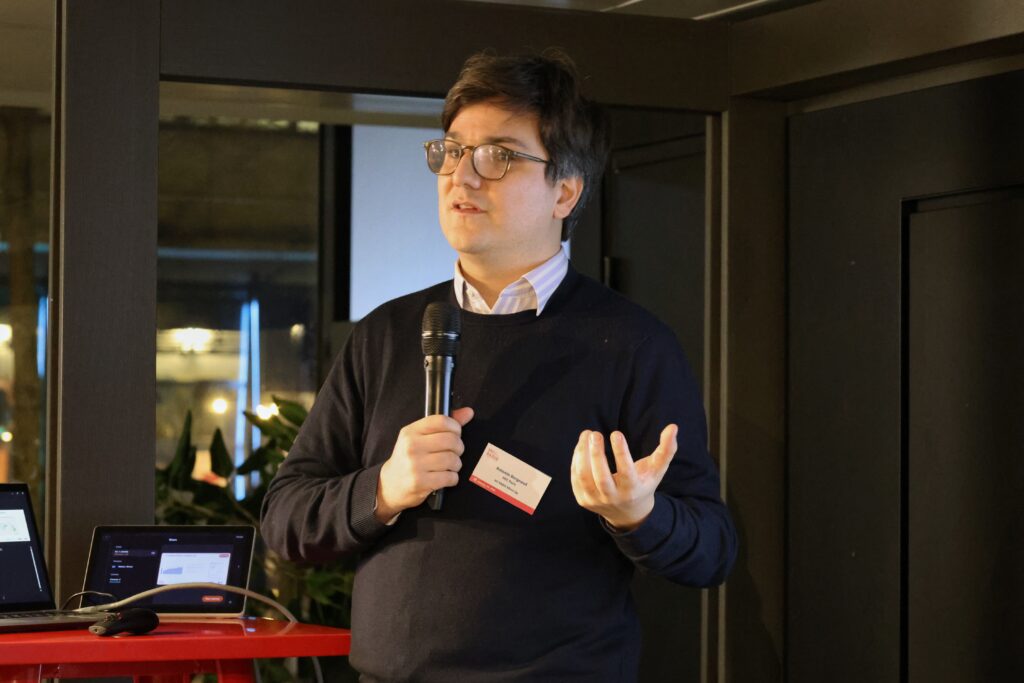
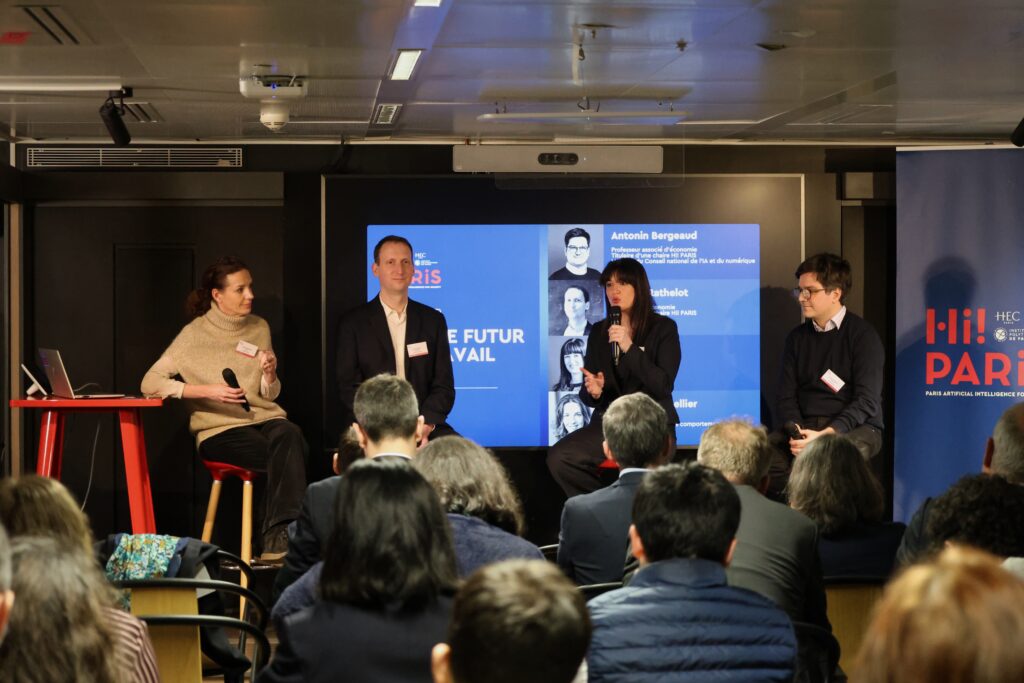
Antonin Bergeaud (HEC Paris) & Roland Rathelot (ENSAE Paris) at Station F during the Meet Up on AI & The Future of Work
If designed poorly, AI can reinforce existing inequalities
If AI optimizes systems, what happens to people who never had access to opportunity in the first place? This is the question raised by Emilie Korchia, founder of MyJobGlasses.
Her starting point is simple: professional orientation remains deeply unequal. Family background, geography, and gender still determine who gets exposed to which careers. Her platform connects 82,000 volunteer professionals with students and job seekers, enabling direct conversations about real work realities. The ambition is explicitly human: reduce information inequality before recruitment even begins.
But AI introduces a paradox. Automated recommendation systems risk reinforcing existing patterns. If young women do not self-identify as future managers or engineers, algorithms trained on stated preferences may never suggest those paths.
Classification can become confinement.
For that reason, MyJobGlasses initially resisted embedding generative AI into certain user interactions. Students must write their own outreach messages. Copy-paste automation is intentionally restricted. Yet AI is not rejected. It is redirected. The platform is developing an AI-powered media library that transforms user conversations into searchable micro-content, allowing future users to access specific insights without replacing human interaction. It is also leveraging aggregated data to inform public policy discussions on orientation and workforce trends. The design principle is clear: AI should amplify human connection, not replace it.

Emilie Korchia (My Job Glasses) at Station F during the Meet Up on AI & The Future of Work
The future of work will depend less on models and more on choices
Taken together, these perspectives complicate the dominant narrative. AI is not yet delivering industrial-scale productivity miracles. It is not (so far) eliminating entire categories of employment at macro scale. It is not automatically aligning with worker preferences.
But it is:
Forcing firms to rethink data foundations
Expanding certain complementary occupations
Improving labor market matching the margins
Raising profound questions about bias and opportunity
Perhaps the most striking insight is this: the greatest risks and opportunities do not lie in model capability, but in system design. Agentic systems can chain tasks. Inference costs are falling rapidly. Infrastructure investment is massive. Yet the transformative potential of AI depends less on computational power than on institutional choices:
How firms structure workflows
How policymakers regulate data and incentives
How designers avoid encoding inequality
How organizations foster adoption without stigma
In that sense, AI is neither destiny nor disruption. It is a tool embedded within social, economic, and organizational systems. The future of work will not be determined by model size alone. It will depend on how deliberately we integrate human and artificial intelligence into the systems that govern opportunity.
And that remains, fundamentally, a human decision.